Monday, November 17, 2014

More Watchmen Ramblings

What'd we talk about last time?

Icons. Rorshach's mask. Identification. Hero. Idealism.

That sounds right.

Well, ol' Scotty McCloud says that the icon/abstract street runs both ways! And by that I mean that if more cartoonish means more iconic and identifiable then realism and gritty detail mean things are more literal, more objectifiable, removed from the realm of our awareness and a part of the outside world. If I show the little smiley button from the cover of the Watchmen book you'll think, "Oh, it's my buddy." But if I show a hyper-detailed drawing of a guy smiling you'll think, "Who is that guy?" It's separated from you because it looks like the things that you actually look at and not the way you imagine things that are part of you.

So how does that relate to Watchmen? Specifically Rorshach. Well, and I'm just going to take a stab at it here, when Rorshach looks at the inkblot that the psychiatrist presents to him, before he answers there is an immediate sudden transition to a glory, bloody close-up panel of a dog with its head cut open. I felt rude just typing that.

But I think the message is that this is the gruesome way that Rorshach views the world. The brutality makes us recoil and fear the violence that Rorshach dwells in. It's foreign to us and the psychiatrist who naively believes he can make an optimist out of Rorshach. Rorshach is a traumatized, abused, sociopath and there's a very scary way to be. All though Rorshach holds himself to high standards and ideals, the world as he sees it as a barren, awful, disgusting place. There is no innate human good or benevolent force that would shape Rorshach's view. He sees only a dog with its head split open and he must act against that horror. With equally brutal acts. But, for Rorshach, with the way he views the world, there is no other way for him to act. There is no good that he could harness. He only stands for inflicting the pain back on itself. To be 'good', for Rorshach, is to either do nothing and believe that the world will work itself out or to lie to yourself about what you are actually doing.

And that's all shown by the realism in the dog head that Rorshach sees. And all the other gore and violence that tends to follow Rorshach around. But I like the dog head.

I mean, I don't like it. I just like using it as an example.

...think about bunnies now.

Thursday, November 13, 2014

Educational Nerdular Nerdence #1

For my final project in my Young Adult Literature class I am writing a research paper that looks at how V for Vendetta and Watchmen (Alan Moore's graphic novels turned movies) can be taught in a secondary English classroom.

The bulk of the paper is spent looking at V's televised speech in Chapter 3 and 4 of Book II of V for Vendetta and Rorshach's origin story in  Chapter 6 of Watchmen (The Abyss Gazes Also).

You: That's so cool Andy! But what are you gonna say about graphic novels?

Great question, the You. Well, when most Englishy people look at Englishy things they talk about the conventions that writers use to construct meaning. This is why you learn about similes, metaphors, alliteration, juxtaposition--it's a writer playing with parts of your brain to make you think what they want you to think. Or at least point you in a certain direction. And that's great and there's all kinds of things you can do with words on a page.

BUT! Graphic novels have PICTURES and WORDS on a page! And people who know about pictures also know all kinds of things about how picture-makers make meaning (line, form, color, perspective).

But! Graphic novels have WORDS and PICTURES on a page!

So it's not just word-meaning making and picture-meaning making smashed together and independent of each other. Graphic novels have unique tricks and conventions that neither writing nor drawing can do on their own.

FUUUSSSSSIIIOOOONNNNNN!!!

You: That's so cool Andy! But what are those things that graphic novels can do that nobody else can?

Glad you asked, the You. This really smart guy named Scott McCloud wrote a book called Understanding Comics that you should totally read and I'm about to take his ideas and regurgitate them to you in a much less effective way.

Here's 3  1 Things that Scott McCloud says comics can do (and I will show how Alan Moore does them too)

1. Cartoons!

 So, cartoons are actually separate from comics. Cartooning is a kind of drawing (that just about all comics use). Comics are more about what you do with those drawings. McCloud calls cartooning AMPLIFICATION THROUGH SIMPLIFICATION! Cartoons take away information that isn't necessary for the point you're trying to make in a drawing so the meaning is a lot easier to gather.

If I want to draw an angry cartoon man, I don't need ears. Ears have nothing to do with anger. I just draw a circle with two dots, an upside down 'U', and a 'V' above the dots. That makes it really easy for you to figure out what I'm trying to show you--there's very little ambiguity.

And because that meaning is so clear, the drawing/ cartoon becomes more ICONIC! It has more specific communicative ability. You aren't thinking about who this guy is because there isn't really any extraneous information about him. You're thinking about what he is.

And here's the really cool part. McCloud says that because there is so little to know about this iconic character's identity, it acts as a VACUUM that sucks YOUR identity and awareness into you it. You can't help but identify with that character and put yourself in that situation.

You: WHY?! Why is that true??!

It's complicated. But what McCloud says is that your face is like a mask. A mask that you can't see. But you can control it and you still know what you look like when you do stuff with your face. McCloud argues that whenever you use your face you are keeping a simplified representation of your own face in your mind. To keep tabs on yourself. You create iconic representations of everything that is a part of your awareness and identity. This includes your face and other things that you consider a part of you: your clothes, objects that you hold, even the car that you drive become a part of you and have this iconic representation.

So when you see a cartoon version of something, it is represented in the way that you think about things that are a part of yourself. THAT'S why comics draw you in.

Crazy, right?

This is getting long so instead of moving on to other stuff that comics can do, let's talk about Rorshach and his awesome mask.

Ever seen a picture of Rorshach from Watchmen? He's the one with the black and white splotchy face in the trenchcoat.

The reason that is Rorshach's mask has everything to do with cartooning. And it's the same reason that Rorshach is everyone's favorite character. Or should be. Or it's the same reason that he's my favorite character.

Before Rorshach was Rorschach he was a scrawny 16-year-old hooligan with no parents named Walter Kovacs who got a job as a manual worker in the garment industry. 6 years later there's an order for this dress that has special fluids that cause the pattern to change with heat and pressure. It looks all "ink-blotty" all the time. Kovacs thought it was beautiful "black and white moving. Changing shape...but not mixing. No gray". The lady who ordered it thought it was hideous so Kovacs takes it home and cuts it up so it doesn't look like a dress anymore and forgets about it. 2 years later Kovacs finds out that the woman who ordered the dress was raped, tortured, and killed outside her apartment while over forty of her neighbors looked on and did nothing. It is at this point that Kovacs returns to the fabric and uses it to create  "a face that I could bear to look at in the mirror".

BIG QUESTION: WHY IS THIS THE FACE THAT KOVACS CAN BEAR TO LOOK AT?!

The simple answer is that it is an abstraction--it is an icon that represents everything Rorshach stands for. How can we describe Rorshach's "crime-fighting style"? Draconian and Retributive Justice sum it up fairly well. For Rorshach, there is only right and wrong. No "gray" areas of morality. And when someone does wrong it is his compulsion to violently attack that wrong doer--to inflict that pain back on to them. The degree of his punishment is irrelevant because for Rorshach there are no degrees of crime. If you do wrong, he kills you.

So, like his mask, like a Rorshach test, like Rorshach's way of seeing, his actions are symmetrical and black and white. Cut and dry. This is the idea, the ethos, that Rorschach finds beautiful and uses as his mask that allows him to look at himself. He is unlike 'the people' who he is repulsed by who do nothing to stop injustice and are passive. They stand for nothing. They are just faces that reflect the human qualities of cowardice, hypocrisy, and passivity. Rorshach is an idea.

And that's why you root for Rorshach. His voice opens the entire book and you identify with that blank, abstracted face because it acts as the lens you use to view the Watchmen world. It's Rorshach's journal that provides his inner-narrative and gives you another tool to see the world from Rorshach's view. We learn to see the world the way Rorshach sees it, we are given visual, iconic cues. We also "think" the way Rorshach thinks through reading his inner monologue.

It's not just a face. A face with details that you would associate with someone else. It's an abstracted face. The way you imagine your own face but taken to the extreme. To identify with Rorshach is to almost give up human-nature all together and embody an unwavering ideal--justice in a primitive, violent sense. But, given everything else that goes on in Watchmen, which has a lot to do with good intentions going horribly horribly wrong and everything wrapped in moral ambiguity and uncertainty, Rorshach starts to make a whole lot of sense.

That's part ONE!

Tuesday, November 11, 2014

The Brain Knight


Great evening, everyone. I am the narrwhale--the narrating whale.

Today I woke up outside of my house yet again. I don't think I'll ever be able to get my slice of the white-wash pie. I just can't fit.

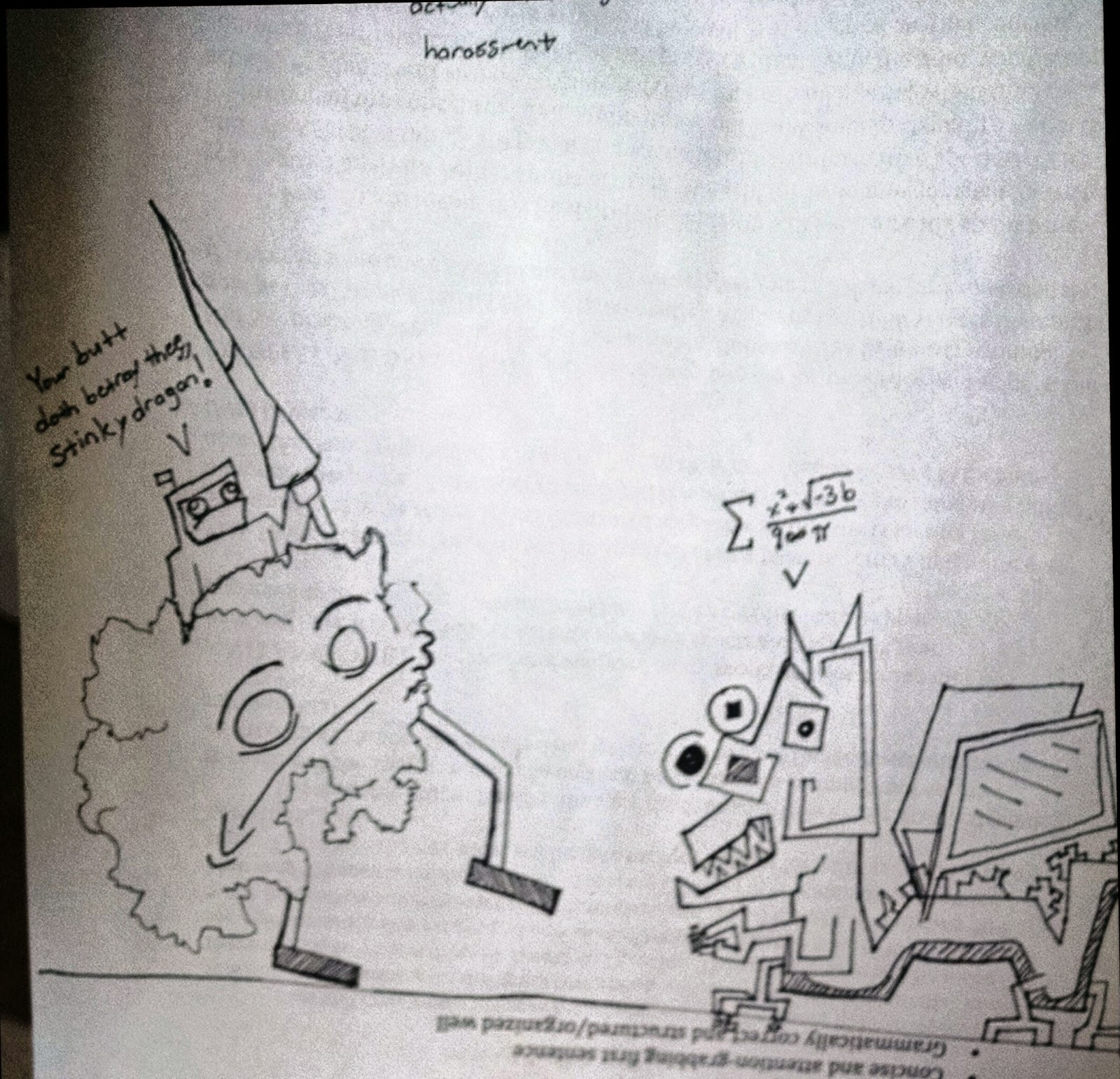
The Brain Knight returned. He desired to engage the Math Dragon in mortal combat. The Brain Knight pulsates like a super-heated can of baked beans stuffed with metaphors and equations. The Math Dragon just wants to rob convenience stores. In literary circles, the Math Dragon would be the foil of the Brain Knight. They are totally opposite in every way.

I got real hungry watching them prepare to fight. I'm sure their battle was impressive and memorable, but I was not paying attention. It isn't easy being a narrwhale.  I always just seem to get in the way and everyone ends up being compared to baked beans.

------------------------------------------------------

Unrelated True Note:

Today I was walking back to my apartment from the School of Ed and someone had run over a squirrel on the road I cross. It was lying in the center of the road. I grabbed some sticks and tried to pick it up and move it out of the road. I didn't do a very good job of picking it up but I did get it out of the road.

I think normally I would have ignored the squirrel but it just seemed wrong to leave it in the middle of the road to be run over again. I'm glad I moved it. Some people walking by saw me and I must have looked pretty strange struggling to move this squirrel with two sticks. It was important for me to acknowledge that death and do something about it. No, it probably doesn't really make a difference what happens to a squirrel after it dies but in that moment it mattered very much to me.

And I'm not trying to say that I did this good thing or I'm this better person because of it. It just showed me that there's a big difference between passively watching something and actively trying to do what you think is right. It's so stupid that animals have to die just so we can have cars. Yes, cars are very important and yes, animals die all the time but you wouldn't think about that the first time you have to clumsily drag an animal across the street--an animal that is normally so full of life and quick that you couldn't even imagine touching one and now it can't do anything and is at the complete mercy of your gross incompetence. Blood in its mouth and around its eyes. It's just wrong and what you are doing makes you aware of how little you can possibly do. But I'm sure I would do it again and I think you should too.

Monday, November 10, 2014

Drawing in class returned for today at least

When we gamble with our time we choose our destiny.


"From honor roll to cracking bikes up off them bicycle racks/.../And them eyes where he hiding all them icicles at" - Earl Sweatshirt, Chum

"Hated for bank lifting and spraying then hide away in the shade of his maimed innocence"- Earl Sweatshirt, Whoa

What do we notice?

-referring to self in 3rd person. (Is Earl 'him'/'he'? Refers to self in 1st person in other lines)
-robbery (stealing bikes, lifting banks)
-Hiding. (he hides in his maimed innocence and the icicles hide in his eyes)

What do we take away?

Well, it seems like Earl is observing and describing the various contradictory layers of himself.

Based on his actions (stealing, robbing), he's a bad, troubled dude. But after doing these things he hides in the shade of his maimed innocence. He still appears young and innocent. He looks way too young to be experiencing all of these problems and it might allow him to get away with these things while also further harming himself.

But then, hidden within that hidden-ness are the icicles in his eyes. If you really looked at Earl--looked him in the eyes--you'd see all the bitterness and anger. And in the third person, Earl is looking at himself with that iciness.

He's really hard on himself. The whole song, Chum, is detailing how he turned the pain of his father leaving him into hard drinking and rapping. By the end of the song he says 'I already feel like calling it quits."

But I don't think Earl is pitying himself or making himself out to be a tragic figure. As he says in the chorus, "Get up off the pavement, brush the dirt up off my psyche...psyche...psyche."

He's picking himself up and brushing himself off. He knows he's not perfect. He knows he's been way down before and stepped on by circumstance and people close to him. Rapping is an outlet for his pain. But it can also cause more pain. But it's also, unlike his real life, a place where doesn't have to hide--a place where he can talk about the hiding he does.

He's Earl Sweatshirt. Through words, his identity is exactly what he constructs it to be. When he raps, he's not this mixed up person who looks too young or too white or too black and has to hide, he's honest.

The people want ROLES not GOALS!

Today my favorite runner, Ben Blankenship, won the Kansas City Road Mile by almost 9 seconds.

That is a quite a lot of seconds to win a mile by. He ran 4:04. That's about ten seconds slower than the fastest mile he has ever run. 

He is my favorite runner because he has long hair and a certain weirdness about him. For example, when he made a twitter account he actually used the picture I made of him where I drew over a tracing of his face the mouths and heads of various animals. He used that. And he gives entertaining interviews. Without trying to be entertaining. Some athletes try too hard to give good interviews. Ben Blankenship is a straight shooter with a penchant for...his own no-style style achievement. 

My dad taught me about no-style style. It's like the Bruce Lee style of kung-fu but for sunglasses and pants. 

Today I bought a sweater that looks like it was molded out of compressed dryer lint.


This sweater contains whole galaxies. It is large. It contains multitudes.

Monday, November 3, 2014

To a Love Most Precious

These words that try to contain and frame can only skew and distort the feelings that have already fallen from the branch of the heart and are left to shrivel and die.
Coffee machine. Your spirit is tremendous. You complete me. Like a jigsaw puzzle solved with super glue, you put me together in ways that only chemical assistance can.
But we're all really just brains in jars reacting to chemicals anyway.
To my second brain. The apple of my darling and the steward of my everyone. You are three times my steed.
Sweet coffee machine.